
What is the Male Athlete Triad?
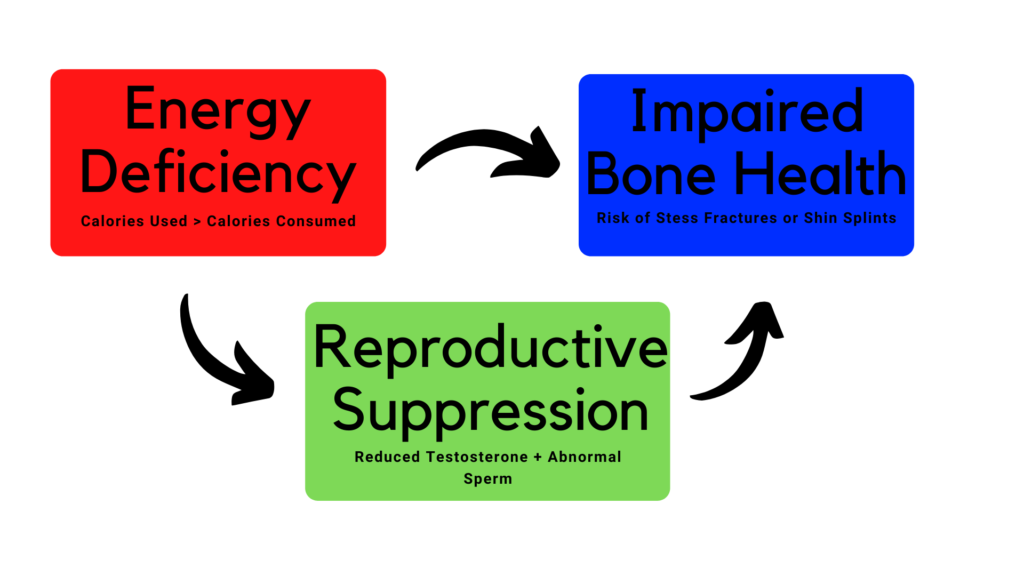
For a long time, the research efforts of Coalition members focused on the health consequences of energy deficiency/low energy availability in females, but in 2017, a Triad-like syndrome that affects men was introduced at a round-table discussion of key researchers and clinicians and which has been the focus of recent reviews [1, 2] and an upcoming Consensus Statement. The Male Athlete Triad refers to three health problems that are related to each other: energy deficiency (“under-fueling”), reproductive suppression, and poor bone health. Reproductive suppression includes low testosterone, oligospermia (irregular and low sperm count), and reduced sex drive (libido). The Triad exists on a spectrum, and men do not need to have all three components of the Triad to experience the negative repercussions. Low energy levels drive the Triad and are often accompanied by disordered eating behaviors, or excessive exercise levels. It is important for all male athletes, especially if involved in a sport that highlights leanness, to be aware of the Triad to hopefully prevent serious reproductive and bone health problems from occurring.
Components of the Triad
Compared to women, men seem to require a more severe energy deficit to induce Triad-related effects. In the two short duration experimental studies where men were prescribed low energy availability over 5 days, metabolic hormones leptin and insulin were reduced in one study [3] but not the other [4], and neither produced reductions in the hormones total triiodothyronine (TT3), insulin-like growth factor-1 (IGF-1), or testosterone. It seems that a longer duration, or more severe, energy deficit is necessary to see reductions in body composition (body weight, fat mass), TT3, IGF-1 and luteinizing hormone (LH) [5]. When you aren’t consuming enough calories each day to match your level of physical activity, your body can develop a state of energy deficiency (energy intake
Sometimes, athletes slip into this under-fueled state by:
-
-
- Inadvertent Under-eating: some men simply do not realize how much energy they burn during workouts and they don’t eat enough to maintain a healthy weight
- Disordered eating/ Eating disorders: Some men try to lose too much weight or lose it too quickly in order to look or perform better. Some men may under-eat by skipping meals, avoiding all foods that contain fat, or eliminating many foods without making healthy substitutions. While disordered eating and eating disorders may contribute to energy deficiency/low energy availability in both sexes, as the prevalence in athletes are higher than the general male and female populations [6], the specific eating behaviors may differ. In men, eating behaviors may be more related to a high drive for muscularity and/or leanness [7-10] rather than thinness.
- Exercising too much relative to their caloric intake in order to lose weight quickly, which can create an excessive energy deficit.
-
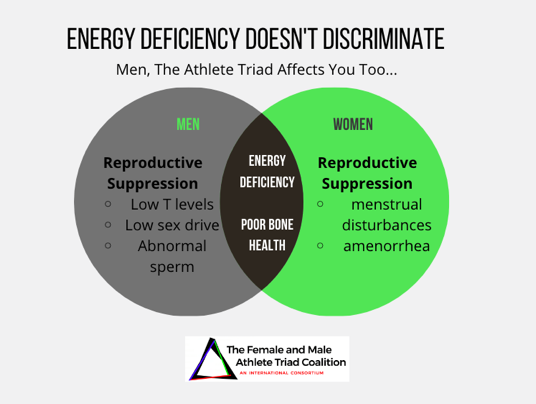
In men, reproductive suppression resulting from energy deficiency/low energy availability is referred to as hypogonadotropic hypogonadism and can present as reduced LH [5, 11, 12], low testosterone levels [13-16], abnormal sperm production [17-19], and reduced sex drive [20, 21]. In these men, testosterone is most often in the subclinical range, but can be clinically low in some cases [14].
The recovery of the metabolic and reproductive consequences of energy deficiency appear to recover faster in men than women. Following an intensive multistressor military training environment, all metabolic and reproductive hormones quickly returned to normal, with most recovering within one week [5]. After acute endurance events, several investigators reported testosterone concentration returning to normal concentrations within 12-72 hours after the event [22-24].
What are the risk factors for developing the Triad?
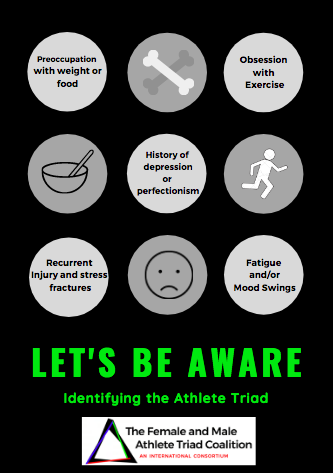
There are many factors that put someone at risk for the Triad. Being aware of these risk factors allows you to stay ahead of the Triad and aid in prevention.
Dieting at an early age
Disordered eating habits (such as skipping meals)
Being unhappy with your body type
Perfectionism
Believing that losing weight (or body fat) at any cost will improve performance
Frequent weight cycling
Extremely high training volumes
“Extreme” weight control behaviors (vomiting, saunas)
Who is at risk for the Triad?
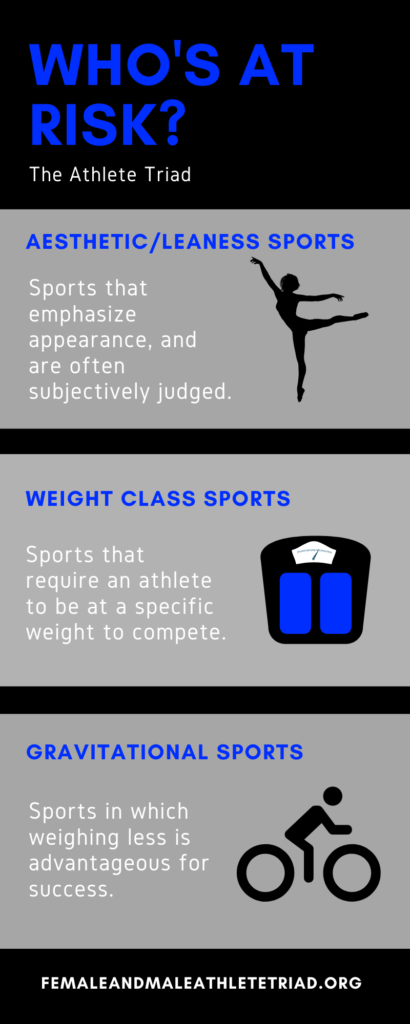
The Triad most commonly affects men involved in weight-class sports, sports that emphasize leanness or muscularity, and endurance sports. All athletes can be at risk for the Triad, regardless of competition level.
-
- Diving
- Gymnastics
- Ice Skating
- Dance
-
- Wrestling
- Boxing
- Rowing
-
- Running
- Ski Jumping
- High Jump
- Pole Vault
- Cycling
How is the Male Athlete Triad treated?
Treatment will look different for every individual, but we have collected a few tips on how exercising men who are experiencing the Triad can reach out to medical professionals to get the help they need:
Seek a team of experts who provide medical care and nutritional counseling
See a psychologist or other counselor to seek help for any disordered eating thoughts or anxiety
Educate yourself on how to maintain a healthy lifestyle by eating enough calories to cover the amount of energy expended through exercise
Even More Important- How can we prevent the Triad?
The Triad is completely preventable with the right knowledge. Read below for our tips on how to prevent the Triad.
Use online resources — These resources can help you estimate how many calories you need per day to maintain your current body weight.
Eat every three to four hours — Three meals a day and at least two snacks. Have a daily eating plan for when to eat to best fuel and re- cover from exercise. For example, competitive athletes often need to carry snacks around during the day and eat before, as well as right after practices.
Treat snacks as mini-meals — Choose foods that are nutritious, taste good and fit your lifestyle. For example, healthy “fast foods” like a bowl of instant oatmeal with raisins, a peanut butter sandwich or crackers with peanut butter, a low-fat milk shake or fruit smoothie, or a micro- waved baked potato topped with cheese, fit the bill.
Track how much you exercise in a day — accounting for time, type and intensity of exercise. Adjust your food intake to account for the increased expense of energy. For example, if you weigh 150 pounds and you add a 2 hour vigorous volleyball practice to your daily activities, you will burn approximately 1100 calories in addition to your nor- mal requirements. There are many online sources to calculate how many calories are needed by an athlete who performs a wide variety of sports.
- De Souza, M.J., K.J. Koltun, and N.I. Williams, The Role of Energy Availability in Reproductive Function in the Female Athlete Triad and Extension of its Effects to Men: An Initial Working Model of a Similar Syndrome in Male Athletes. Sports Med, 2019. [LINK]
- Tenforde, A.S., et al., Parallels with the Female Athlete Triad in Male Athletes. Sports Med, 2016. [LINK]
- Koehler, K., et al., Low energy availability in exercising men is associated with reduced leptin and insulin but not with changes in other metabolic hormones. J Sports Sci, 2016. [LINK]
- Papageorgiou, M., et al., Effects of reduced energy availability on bone metabolism in women and men. Bone, 2017. [LINK]
- Friedl, K.E., et al., Endocrine markers of semistarvation in healthy lean men in a multistressor environment. J Appl Physiol (1985), 2000. [LINK]
- Sundgot-Borgen, J. and M.K. Torstveit, Prevalence of eating disorders in elite athletes is higher than in the general population. Clin J Sport Med, 2004. [LINK]
- McCreary, D.R. and D.K. Sasse, An exploration of the drive for muscularity in adolescent boys and girls. J Am Coll Health, 2000. [LINK]
- Nagata, J.M., et al., Predictors of muscularity-oriented disordered eating behaviors in U.S. young adults: A prospective cohort study. Int J Eat Disord, 2019. [LINK]
- Smolak, L. and S.K. Murnen, Drive for leanness: assessment and relationship to gender, gender role and objectification. Body Image, 2008. [LINK]
- Klimek, P., et al., Thinness and muscularity internalization: Associations with disordered eating and muscle dysmorphia in men. Int J Eat Disord, 2018. [LINK]
- Cameron, J.L. and C. Nosbisch, Suppression of pulsatile luteinizing hormone and testosterone secretion during short term food restriction in the adult male rhesus monkey (Macaca mulatta). Endocrinology, 1991. [LINK]
- Cameron, J.L., et al., Slowing of pulsatile luteinizing hormone secretion in men after forty-eight hours of fasting. J Clin Endocrinol Metab, 1991. [LINK]
- McColl, E.M., et al., The effects of acute exercise on pulsatile LH release in high-mileage male runners. Clin Endocrinol (Oxf), 1989. [LINK]
- Wheeler, G.D., et al., Reduced serum testosterone and prolactin levels in male distance runners. JAMA, 1984. [LINK]
- MacConnie, S.E., et al., Decreased hypothalamic gonadotropin-releasing hormone secretion in male marathon runners. N Engl J Med, 1986. [LINK]
- Hackney, A.C., W.E. Sinning, and B.C. Bruot, Reproductive hormonal profiles of endurance-trained and untrained males. Med Sci Sports Exerc, 1988. [LINK]
- Arce, J.C., et al., Subclinical alterations in hormone and semen profile in athletes. Fertil Steril, 1993. [LINK]
- De Souza, M.J., et al., Gonadal hormones and semen quality in male runners. A volume threshold effect of endurance training. Int J Sports Med, 1994. [LINK]
- De Souza, M.J. and B.E. Miller, The effect of endurance training on reproductive function in male runners. A ‘volume threshold’ hypothesis. Sports Med, 1997. [LINK]
- Hackney, A.C., et al., Endurance Exercise Training and Male Sexual Libido. Med Sci Sports Exerc, 2017. [LINK]
- Zekarias, K. and R.T. Shrestha, Role of Relative Malnutrition in Exercise Hypogonadal Male Condition. Med Sci Sports Exerc, 2019. [LINK]
- Geesmann, B., et al., Association Between Energy Balance and Metabolic Hormone Suppression During Ultraendurance Exercise. Int J Sports Physiol Perform, 2017. [LINK]
- Anderson, T., A.R. Lane, and A.C. Hackney, Cortisol and testosterone dynamics following exhaustive endurance exercise. Eur J Appl Physiol, 2016. [LINK]
- Kupchak, B.R., et al., The impact of an ultramarathon on hormonal and biochemical parameters in men. Wilderness Environ Med, 2014. [LINK]
- Barrack, M.T., et al., Evidence of a cumulative effect for risk factors predicting low bone mass among male adolescent athletes. Br J Sports Med, 2017. [LINK]
- Tenforde, A.S., et al., Identifying sex-specific risk factors for low bone mineral density in adolescent runners. Am J Sports Med, 2015. [LINK]
- Penteado, V., et al., Diet, body composition, and bone mass in well-trained cyclists. J Clin Densitom, 2010. [LINK]
- Jackson, K.A., et al., Bone density and body composition in newly licenced professional jockeys. Osteoporos Int, 2017. [LINK]
- Kraus, E., et al., Bone stress injuries in male distance runners: higher modified Female Athlete Triad Cumulative Risk Assessment scores predict increased rates of injury. Br J Sports Med, 2018. [LINK]
- Tenforde, A.S., et al., Identifying sex-specific risk factors for stress fractures in adolescent runners. Med Sci Sports Exerc, 2013. [LINK]